


Wet sanding gelcoat runs P600 to P1500 on a whole surface, and P320 to P400 only on a repair patch that has to be brought flush. Gelcoat is a pigmented polyester resin skin, far thicker than automotive clear coat, so it tolerates a coarser start — but it also cuts faster than people expect once they lean on the paper. Each stage stops when its scratch pattern is even and the surface is still matte. Gloss never comes from the paper: if the gelcoat starts to shine under the sheet, the paper has loaded or the job is finished, and either way more sanding only removes resin you cannot put back.
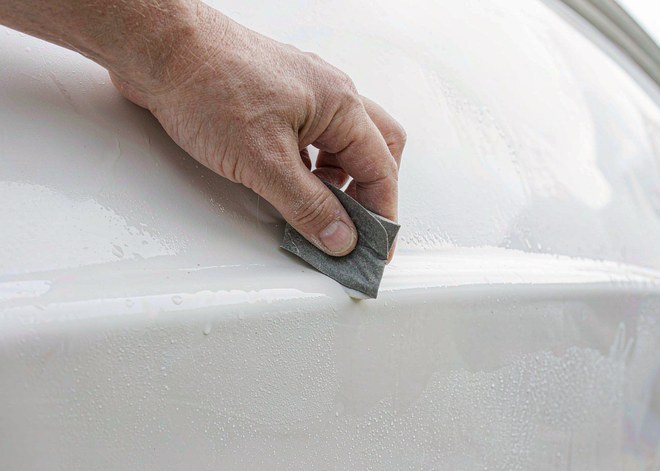
Gelcoat is the outer skin of a fiberglass hull, deck or mold — a filled, pigmented polyester resin laid up in the mold, not a sprayed lacquer measured in microns. Three properties drive every grit decision.
Thickness. There is real material to level, so a full panel can enter the ladder at P600 to P800. Automotive clear coat at that grit would be gone in a pass.
Softness. Cured gelcoat gums a dry sheet almost immediately, and friction heat leaves glossy burnished patches that later refuse to take compound evenly. Water under every stroke is not a refinement here; it is the method.
Cure. Gelcoat that is merely dry to the touch will tear and drag under the paper. Press a thumbnail hard into a hidden area: if it dents, the resin is still soft. Cold weather stretches cure badly, and below roughly 15 °C (60 °F) many shops stop laying up rather than gamble on a patch that will sand badly a week later.
There is also the surface itself. Gelcoat oxidizes and chalks in UV, which is why a weathered hull looks dull long before it is damaged. Wet sanding removes that dead layer and exposes fresh resin; it does not restore a gelcoat that has worn through to laminate, and no grit sequence will.
| Stage | Grit | Method | Stop when |
|---|---|---|---|
| Leveling a cured repair patch | P320–P400 | Wet, hard block, patch only | The patch is flush with the surrounding gelcoat — feel it, do not eyeball it |
| Removing the P320–P400 scratches | P600 | Wet, whole panel | Even matte, no deep lines left |
| Orange peel or oxidation on a whole surface | P600–P800 | Wet | One continuous dull haze across the panel |
| Refining | P800–P1000 | Wet | Previous scratch pattern fully replaced |
| Final before compounding | P1200–P1500 | Wet | Smooth, dull, even luster |
The rule behind the table is the same one that governs wet sanding car paint: every grit exists to erase the scratches of the one before it. What changes on gelcoat is where you may enter and how much each stage is allowed to remove.
Feather the repair outward as you go up the ladder — extend each finer pass slightly past the patch edge so the transition into original gelcoat blurs instead of showing as a ring. Keep both the surface and the sheet flooded, rinse the paper often, and wipe the panel dry between grits, because a wet surface hides the scratches you are trying to judge.
Sanding gelcoat has exactly one correct end state: an even, dull, chalky haze with no deep marks under low-angle light. That haze is what compounding removes.
The signal to stop early is gloss. A patch that starts to shine under the sheet is being burnished, not cut — usually because the paper has loaded with resin dust and is now polishing with a crust. Swap to a fresh section, rinse the surface, and if the gloss persists, drop back a grit rather than pushing on. Continuing over a loaded sheet adds heat, and heat is what turns a sanding job into a repair.
The other stop signal is feel. Run your fingertips across the work: a surface that is still grabbing or dragging is not finished at that grit, and one that feels glassy but shows no reflection is ready to move up. Fingertips catch what eyes miss under shop lighting.
The P1200–P1500 haze does not polish out by sanding finer. Wipe the area clean and dry — residue contaminates pads and dulls the cut — then work a cutting compound on a wool or firm foam pad in small sections until the haze lifts. Follow with a finer polish on a soft pad, and finish with wax or a sealant.
A freshly sanded and compounded panel is bare, exposed resin and takes UV and salt damage faster in its first season than at any other time, so the protection step is part of the job, not an upsell. Film-backed papers and their place in high-gloss marine work are covered in sandpaper films for boat and yacht refinishing. For the paper itself, the wet grades used on hulls and decks come from the same silicon carbide family as automotive work — start with silicon carbide waterproof paper. The trade also sells it as waterproof emery paper, and the reason the backing survives a flooded panel is worth knowing before you buy by price alone.
On a whole surface — orange peel, oxidation or a dull finish — start at P600 wet and move up through P800 and P1000 to P1200–P1500. On a cured repair patch standing proud of the surface, level it flush at P320–P400 first, then rejoin the ladder at P600. Starting finer than P600 on a full panel wastes time; starting coarser than P320 anywhere removes more resin than you intended.
Practically, no. Dry paper loads with resin within a few strokes, and the friction heat burnishes glossy patches that polish out unevenly later. If a spot has to be touched dry — checking a pinhole, for example — keep it to a couple of light strokes on fresh paper and plan to wet sand the area properly afterward.
Resin dust is sticky, so loading is a pace problem as much as a paper problem: too much pressure, too little water, or a sheet worked long past its life. Flood the surface, rinse the sheet often, tear fresh sections instead of wearing one to death, and let the silicon carbide cut rather than leaning on a loaded sheet.
Press a thumbnail hard into an inconspicuous spot. A dent means the resin is still soft; give it more time. Cool weather stretches cure well beyond the printed time, so a cold workshop can stall a repair for days. Sanding a soft patch tears it rather than leveling it.
Yes, unless a matte finish is the goal. Wet sanding leaves an even haze that only compounding removes — no grit is fine enough to bring gelcoat to gloss in a sensible number of passes. Compound after the final P1200–P1500 pass, then polish, then protect.

 English
 中文
 한국어
 français
 Deutsch
 Español
 italiano
 русский
 português
 العربية
 tiếng việt
 Polska