

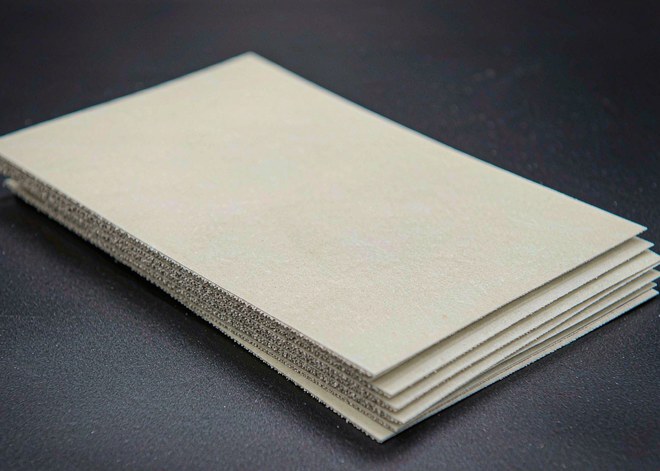
Stearated sandpaper is coated abrasive with a top dressing of zinc stearate — a dry, soap-like lubricant that stops paint, primer and resinous wood dust from welding onto the grain. On gummy materials a plain sheet loads within a minute and stops cutting; a stearated sheet keeps cutting several times longer, which is why body shops and furniture plants buy it by the box. The trade-offs are real: a slightly slower cut, a faint milky residue that has to be wiped off before a water-based finish, and no benefit at all on wet work or on hard, clean materials. It earns its price on dry sanding of paint, primer, filler and softwood, and is wasted money almost everywhere else.
Zinc stearate is a metal soap of stearic acid: a white, waxy, water-repellent powder. In manufacturing it is applied over the size coat, so it coats the abrasive grain and, mostly, the resin holding that grain to the backing. At the contact point it behaves as a dry lubricant. When a paint particle or a wood fiber reaches the grit, the stearate layer stops it fusing to the grain and to the bond the way resin dust normally does, so the debris falls clear instead of building a crust.
That crust is what kills a sheet on soft materials. Once dust welds between the grains, the sheet stops cutting and starts burnishing; heat builds, the operator presses harder to compensate, and the extra pressure loads it faster still. Stearate attacks the cause rather than the symptom: the sheet keeps cutting until the grain itself wears out, so life on paint goes up by a multiple rather than a percentage. The same treatment is applied across the whole stearated sandpaper range, in sheets, rolls, belts and discs.
What it does not do is change the cut of the grain or the meaning of the grit number. A P240 stearated sheet removes the same scratch as a P240 plain sheet. It just keeps doing it for longer on materials that would otherwise clog.
| Job | Stearated? | Reason |
|---|---|---|
| Dry sanding primer, paint or body filler | Yes, first choice | These load plain paper in under a minute; stearate keeps the sheet cutting across a whole panel |
| Softwood, pine, resinous stock | Yes | Rosin is the classic clogging material; anti-clog sheets were developed for furniture work |
| Stripping old varnish or polyurethane, dry | Yes | Old finish gummifies under friction, and the coating buys many more strokes per sheet |
| Bare hardwood, dense stock, steel | No real gain | Hard, dry chips clear the grain on their own; there is nothing sticky to repel |
| Any wet sanding | No | The coating is water-repellent and not intended for wet work — wet belongs to silicon carbide on waterproof paper |
| The last pass before a water-based topcoat | Avoid | Residue interferes with adhesion; if used, wipe down before finishing |
The pattern behind the table: stearate buys sheet life where the dust is sticky. Where chips are hard and dry, or the process is wet, the layer adds cost and residue and returns nothing.
Two habits carry over unchanged — light pressure and a sheet that keeps moving — and two change.
Judge the sheet by cut, not by color. A working stearated sheet picks up a pale film as the coating sheds with the debris. That is the product doing its job, not a signal to change sheets. Swap when the cut slows or the surface stops improving.
Wipe before finishing. Zinc stearate transfers a faint milky film to the workpiece. It is harmless on its own but interferes with the adhesion of water-based finishes, so wipe with a tack cloth, or a damp wipe followed by a dry one, before staining or topcoating. Under solvent-based coatings a dry tack-off is normally enough.
Grit selection does not change, but the ladder does shift slightly in practice: because loading is no longer the limiting factor, operators tend to work coarser grits longer and skip fewer steps. That is the right instinct on paint and filler, where jumping grits leaves scratches that the topcoat magnifies.
Two stearated lines cover most of the work, and the spec sheets say what the coating is rather than leaving it to the label.
The RS33 is aluminum oxide grain on C-weight paper, resin-over-resin bonded, in P40 to P600, supplied as sheets, rolls, belts and discs; the standard sheet is 230 × 280 mm (9 × 11 in). It is the general-purpose choice for primer, paint, wood and metal, and its intended uses include automotive, furniture and general surface sanding.
The AP33M is the finer end: A-weight latex paper, resin-over-resin bond, P60 to P1000, with a semi-open coat and a load-resistant coating. It is built for high-production work on paint, primer, wood, metal, plastic and composites including fiberglass, and it is commonly converted into hook-and-loop or PSA discs and narrow abrasive roll stock.
Between the two, the grit range runs P40 to P1000. If your job needs finer than P1000 with anti-clog behaviour, that is a different product family — and if the job is wet, stearate is the wrong tool regardless of grit. Wet sandpaper vs dry sets out where the water process takes over.
Zinc stearate is a dry powder dressing, not a cured film, so storage is about protecting a surface rather than preserving a chemistry. Keep sheets flat and dry: humidity buckles any coated abrasive backing, and heat softens the bond under the grain. Do not slide sheets across each other in a drawer — the abrasion scuffs the coating off the faces you will sand with.
No supplier publishes a hard shelf life for stearated stock, and the practical test beats the calendar. A sheet that loads on paint noticeably faster than a new one from the same case has lost its effective coating, however recently it was bought. Buy what you will use inside a season of production rather than papering the warehouse.
Three checks, cheapest first.
Read the spec sheet. It should name the treatment explicitly — zinc stearate, anti-clog, non-loading — next to backing weight and bond type. A page that only says "premium grain" is telling you nothing about loading.
Look at the sheet. Stearated stock has a pale, slightly matte top surface against the darker grain layer of an untreated sheet. Suggestive, not conclusive.
Run a side-by-side. Sand a strip of fresh primer or resinous pine with the suspect sheet and a plain aluminum oxide sheet of the same grit. The plain sheet will crust over within a minute or two; a genuine stearated sheet keeps cutting. Two sheets settle in the shop what a photograph cannot settle online.
One related habit belongs here: the between-coat pass on an oiled surface is where anti-clog paper earns its keep on wood, and the grit ladder for that whole process is set out in sanding wood before oiling.
Yes. "Non-loading" describes the result, "stearated" describes the coating that produces it. Any sheet sold as non-loading is top-dressed with zinc stearate or a similar dry lubricant, and the two words are used interchangeably on spec sheets and boxes.
No. The layer is water-repellent and non-loading sheets are not built for wet sanding — water washes the coating off unevenly and the sheet behaves unpredictably. Wet work belongs to silicon carbide on a waterproof backing, which keeps cutting under a flood of water with no dry lubricant involved.
Usually pressure, sometimes the material. Stearate stops dust welding to the grain, but it cannot eject debris you have forced into the sheet, so heavy hand pressure defeats the coating. Ease off and keep the sheet moving. On hard, dry materials even a good stearated sheet loads eventually, because there was never anything sticky to repel.
Yes, a faint milky film of zinc stearate transfers as the coating sheds. It is harmless on its own but interferes with water-based finish adhesion, so wipe it off before staining or topcoating. Under solvent-based paint a dry tack-off is usually sufficient.
P40 to P1000 across the two common lines: P40–P600 on RS33 aluminum oxide, P60–P1000 on AP33M latex paper. Coarse grades handle filler shaping and stripping, mid grades cover primer and between-coat work, and the fine end serves the last pass before finishing.

 English
 中文
 한국어
 français
 Deutsch
 Español
 italiano
 русский
 português
 العربية
 tiếng việt
 Polska