


Sanding wood before oiling comes down to stopping early. Run P80 to P120 to P180 on hardwood furniture, stop at P120 on flooring, and go no finer than P220 anywhere before the first coat — an oil finish needs open pores to soak into, and a burnished surface takes up oil unevenly. Re-cut lightly at P320 between coats, when the goal changes from opening the wood to smoothing a cured film. Sand with the grain, vacuum and wipe after every grit change, and pick your final grit from the finish chemistry rather than from habit: the same P320 surface that makes a lacquer look flat will make an oil look blotchy.
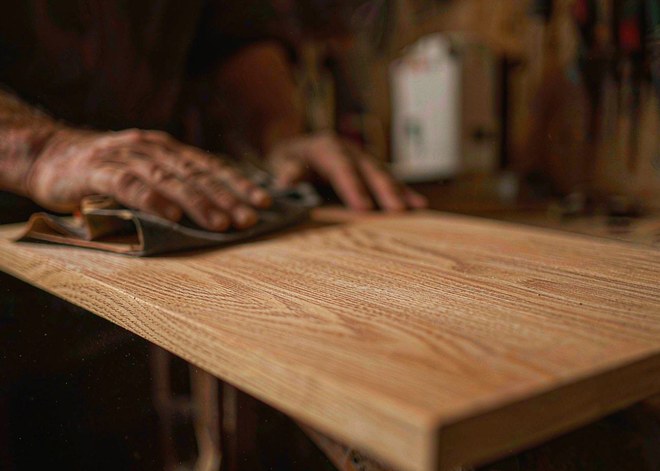
A penetrating oil and a hardwax oil both rely on the wood's pore structure to hold them. The last grit you use sets how open that structure is, and the effect is larger than most people assume. Osmo's own sanding preparation guide grades it plainly: P120 gives the best absorption for a hardwax-oil finish, P180 is still good for general and furniture work, P320 drops absorption to low and is listed only as a between-coat grit, and P400 is poor. Sand finer than the finish can use and the oil sits on the surface, wears off sooner, and stains more easily — while you spent extra hours making it happen.
The sequence matters as much as the endpoint. Each grit has to erase the scratches of the one before, and a skipped step leaves deep lines that pigment settles into. That is why blotchy color almost always traces back to a skipped grit, a cross-grain scratch or an uneven pass, and rarely to the oil itself. On flooring it shows as dark streaks at every machine pass; on furniture it pools along edges and armrests where the sander lingered. If your P numbers and the paper in the drawer do not line up, abrasive paper grades explains how the P and CAMI scales differ.
One more variable: film finishes and oils want opposite surfaces. Lacquer, polyurethane and water-based coatings build a layer that hides fine scratches, so they are commonly sanded to P220 and beyond. Oil does not build that layer. Match the grit to the finish, not to what the last job needed.
| Wood and job | Sequence | Final grit | Why it stops there |
|---|---|---|---|
| Hardwood furniture — oak, ash, walnut | P80 → P120 → P180 | P180, up to P220 on tight-grain stock | Opens the grain for even absorption; finer burnishes it closed |
| Flooring, clear hardwax-oil | P40 → P60 → P80 → P120 | P120 | Osmo's flooring spec; a walking surface needs absorption, not polish |
| Flooring, colored finish | P40 → P60 → P80 → P120 → P150 | P120–P150 | Pigment collects in sanding marks, so the surface has to be more even |
| Resinous softwood — pine, cedar, fir | P80 → P120 | P120–P150 | Resin gums fine paper and burnishes; penetration beats smoothness |
| Previously finished wood | Strip the finish → P40 → P60 → P80 → P120 | P120 | Old film comes off first, then the surface is rebuilt from coarse |
Two rules hold across every row. Sand with the grain: a cross-grain scratch cannot be removed later without dropping back several grits, and under oil it prints as a permanent dark line. And never jump more than about one step, because the finer paper cannot reach the bottom of a scratch it skipped.
The finest grit sandpaper for wood that belongs before an oil coat is P220, and only on close-grained hardwood. Treat anything finer as between-coat stock, not first-coat stock — that is exactly what stearated sandpaper in the P320 and finer range is for.
Sanding wood before oiling is only half the sequence; the other half happens after the first coat. Once it has cured, a light re-cut knocks down raised grain and any dust nibs, and gives the second coat a uniform surface to sit on. This is the one place fine paper earns its keep: P320, feather-light, with the grain, just enough to feel the difference. You are smoothing a cured film, not opening wood, so the absorption penalty does not apply.
Resinous species clog fine paper fast, which is where an anti-clog or stearated sheet helps — the coating keeps softwood dust from welding to the grain. Two cautions come with it: stearate leaves a faint milky residue that interferes with adhesion of water-based topcoats, so wipe down before recoating, and a loaded sheet cuts nothing, so change it rather than pressing harder.
Dust removal is not optional between coats. Vacuum the surface and the joints, then lift the remaining dust out of the pores with a tack cloth or lint-free wipe. Osmo's guidance is explicit that dust left in the grain prevents the finish bonding to the fibers and produces a patchy result — and that grease, oil or cleaning residue has to come off entirely before the first coat, because oil will not bond where they sat.
If you cut your own sheets from stock, working from a roll keeps the grit sequence consistent across a batch of parts — woodworking sandpaper rolls cover the widths and backings used for panel and furniture work.
P180 is the dependable default for furniture and joinery, P120–P150 for flooring, and never finer than P220 before the first coat. Close-grained hardwood can take a final P220 pass. Beyond that you are closing pores the oil needs, which costs durability and invites blotching.
Yes, and it is the most common way an oil finish fails before it starts. Past roughly P220–P320 the surface burnishes and the pores close, so oil cannot penetrate evenly. The result is lower water resistance and stain resistance — the exact defects fine sanding was supposed to prevent.
P320, applied lightly with the grain once the first coat has cured. The aim is to level raised grain and nibs, not to remove film. Wipe or vacuum all dust off before the next coat; between-coat dust is the usual cause of specks trapped in the final surface.
Stop earlier. Resinous softwoods gum abrasive and burnish at finer grits, so the ladder usually ends at P120–P150 rather than P180. On pine and cedar, oil penetration matters more than surface polish, and a burnished softwood absorbs unevenly — which reads as blotching under any pigmented finish.
Yes. Water-based coatings and lacquer build a film and hide fine scratches, so they are usually sanded to P220 and finer. Those same fine surfaces are what a penetrating oil cannot absorb through. Choose the final grit from the finish chemistry, not from what the previous job used.

 English
 中文
 한국어
 français
 Deutsch
 Español
 italiano
 русский
 português
 العربية
 tiếng việt
 Polska