


Steel wool runs from grade 0000, the finest, up to grade 4, the coarsest — more zeros mean finer fibers, so the scale reads backwards compared with sandpaper grit numbers. The grade sets how much material a pad removes and how deep the scratches it leaves will be. Pick the grade by the task: 0000 for final buffing and delicate cleaning, grades 1–2 for scrubbing and floor work, grades 3–4 for stripping paint and heavy rust. This page maps every grade to its typical tasks, shows where each grade stops working, and explains how grade relates to the finish you end up with.
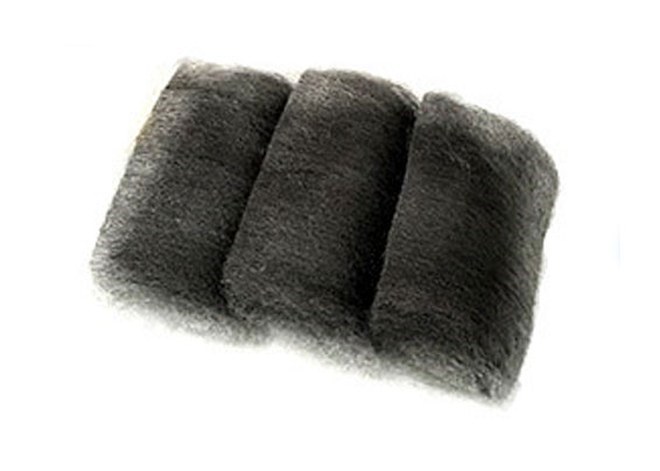
The whole scale fits in one line: 0000 (finest) → 000 → 00 → 0 → 1 → 2 → 3 → 4 (coarsest). In practice the range splits into three jobs:
When a job sits between two grades, start with the finer one. A pad that is too coarse leaves scratches you will spend twice the time removing. RMC (Zibo Sankyo Rikagaku) supplies steel wool across the full grade range — the steel wool grades and specifications on the product page show what is available in each grade.
The grade is the thickness of the steel fiber, nothing else. Steel wool is shaved off low-carbon steel rod with a serrated cutting tool; more serrations yield a finer fiber and a finer grade, fewer serrations yield a coarser one. That is why the scale runs 0000 → 4 from finest to coarsest — the opposite direction of the sandpaper grit scale, where a higher number means a finer abrasive. If you keep one rule in mind, keep this one: more zeros = finer wool, higher numbers = coarser wool.
Because the fiber thickness fixes the cut depth, you cannot make a coarse pad behave gently by pressing lightly. Grade 4 will scratch whatever it touches; the only question is how much.
The table lists what each grade does best in common workshop and household use, and the surfaces it should stay away from.
| Grade | Common name | What it does best | Keep it off |
|---|---|---|---|
| 0000 | Super fine | Buffing final coats of wax, oil, shellac and varnish; cleaning glass and windows; removing light rust spots from chrome | Heavy rust, thick paint — too fine to cut |
| 000 | Extra fine | Polishing aluminum, copper, brass and zinc; buffing cabinetry and new wax finishes; removing paint drips | Rough castings, deep scratches |
| 00 | Fine | Cutting a gloss finish back to semi-gloss before recoating; cleaning screens, golf clubs and metal furniture | Softwood that dents easily, polished stone |
| 0 | Medium fine | Cleaning barbecue grills, porcelain, tile and grout; removing light rust from hand tools with a little oil | High-gloss painted surfaces |
| 1 | Medium | Preparing wood for its first coat of paint; smoothing raised grain; scrubbing resilient floors | Finished furniture, thin sheet metal |
| 2 | Medium coarse | Removing scuff marks and old floor wax; cleaning rough metal, stone and glass block; rust on garden tools | Anything with a finish you intend to keep |
| 3 | Coarse | Stripping old paint and varnish; cutting back hardened oil finishes; heavy cleanup on cast iron | All decorative and finished surfaces |
| 4 | Extra coarse | Removing the toughest rust, dirt and old paint; cleaning engine parts | High-gloss and delicate surfaces of any kind |
Task lists reflect the grade charts published across the steel wool industry; conventions vary slightly between makers, so test on scrap before committing a batch. For a closer look at how abrasive grit numbers work on sandpaper, see how to choose abrasive paper grit size.
Every failure here is a mismatch of grade to task, and it damages the work rather than the pad. Three cases cover most of it:
There is also a shape problem: a pad flexes, so on large flat panels it rounds edges and misses high spots. Flat work belongs to sandpaper on a block; steel wool earns its place on profiles, turnings and carved detail.
Every grade leaves its own scratch depth, and the finish shows every scratch it inherits. That is why the sequence matters more than the final grade: work coarse to fine, and each grade erases the scratches of the one before it. Skipping from grade 1 straight to 0000 leaves medium scratches that the final buff cannot remove — they surface after the first coat of finish goes on, which is the most expensive moment to find them.
Between coats of varnish or oil, 0000 or 000 with a little wax or mineral oil is the standard pass: it knocks back dust nibs and gives the next coat something to grip. Work along the grain with light pressure, and remove all fibers before the next coat.
For jobs that need a flatter, more measurable cut — wet sanding paint, stone or glass — sandpaper takes over from steel wool. The uses of waterproof abrasive paper cover that side of the bench.
Yes. Each added zero means a finer fiber, so 0000 is the finest grade made, and grade 4 is the coarsest. The zero-count only runs down to 0000; after that the scale switches to plain numbers, which go coarser.
Grade 2–3 handles rust on tools and garden equipment, ideally with a little oil as a lubricant. Heavy, flaking rust needs grade 4 first, then step down to 0 or 00 to even out the surface. Grade 0000 only polishes off the faintest bloom on chrome.
Fine grades (0000–00) are safe on window glass for removing film and grime, which is why glaziers use them. They polish; they do not reshape. Cutting or smoothing glass edges needs silicon carbide wet paper instead.
0000 for most finishes, or 000 when the previous coat has visible nibs. Wipe or vacuum the fibers off completely — a steel fiber left under the next coat will rust and leave a dark dot.
Leftover fibers rusted inside the wood pores and reacted with the tannins. That combination turns oak and similar woods blue-black, particularly under water-based finishes. Brush out every fiber, or use bronze wool and synthetic pads on tannin-rich wood.

 English
 中文
 한국어
 français
 Deutsch
 Español
 italiano
 русский
 português
 العربية
 tiếng việt
 Polska