


A sandpaper roll decision has four variables — width, grit, backing and roll length — and two of them are set by your machine, not by preference. Decide first what the roll has to do in your process: feed it whole into a machine, slit it into discs or sheets, or cut-to-length by hand. Width and core size follow from that answer, grit comes from the coarsest defect you must remove, and backing follows whether the job runs wet or dry. This page gives the decision order, a machine-to-spec mapping, and the checklist to send a supplier when you request a quote.
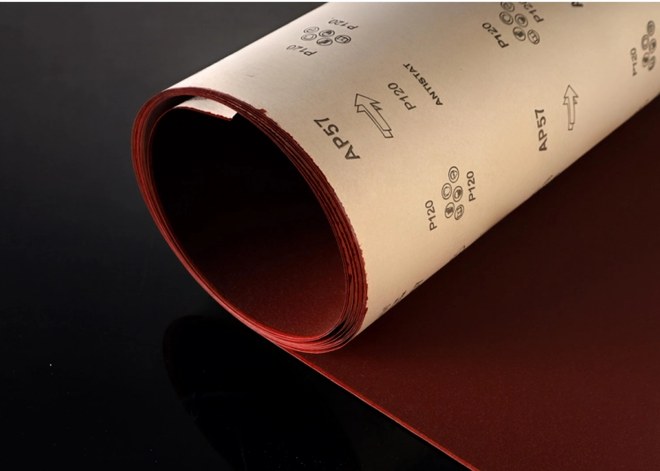
Rolls exist because cutting abrasives to shape at the point of use is cheaper than stocking every size pre-cut. In practice a roll plays one of three roles:
Name the role before you look at any spec sheet. Everything else in this page hangs off it.
The variables are not equal, and picking them in the wrong order is the most common procurement mistake:
Get 1–3 right and the roll earns its place; get them wrong and no price makes it a bargain.
| How the roll is used | What width must cover | What to check on core and winding | Common mistake |
|---|---|---|---|
| Fed whole into a machine (holder, feed arm, drum) | Must match the machine's rated width — no wider, no narrower | Core inner diameter fits the machine mandrel; winding is square-edged so the roll tracks straight | Ordering by approximate width and shimming the difference |
| Slit into discs or strips | A multiple of the piece width plus a kerf allowance per cut | Consistent thickness edge to edge, so every slit piece finishes the same | Ignoring edge trim loss, then coming up short on pieces per roll |
| Cut by hand at the bench | Wide enough to wrap the block or fold double; narrow enough to control | Backing flexibility — a stiff sheet-weight backing fights the fold | Buying machine-grade stiffness for hand work |
| Wrapped around shaped tools (profiles, dowels, tubes) | Slightly wider than the contact face of the tool | Backing must tolerate repeated bending without cracking the bond | Choosing a heavy backing that cracks at the fold line |
Ranges of stock widths and core diameters differ between manufacturers, and slitting capability is a service, not a product line. When you request a quote, send your machine list or your piece sizes and ask the supplier to match width and core to it — the sandpaper rolls page lists what RMC can supply and convert.
Grit selection for rolls follows the same ladder as sheet goods: start from the coarsest grit that removes your worst defect in a reasonable time, then step one or two grades finer to erase the scratch pattern, and never skip more than one step on the way down. Buying a roll assortment that brackets the ladder — one coarse, one middle, one fine — beats buying three of the same grit, because the coarsest paper in the shop is not the one that wears out first; the middle one is. The full logic, with the grit ladder per material, is in how to choose abrasive paper grit size.
Backing decides where the roll survives. Three families cover nearly every roll application:
| Backing | Suited to | Why it works | Watch out for |
|---|---|---|---|
| Dry paper | Wood, dry surface prep, general shop use | Lower cost per meter, stiff enough for flat hand sanding on a block | Falls apart when wet; tears on curved metal work |
| Waterproof (latex-treated) paper | Wet sanding: paint, primer, metal, stone, glass | The treated backing holds together soaked, and flushing swarf keeps the grain cutting | Paying for water resistance on dry-only jobs |
| Cloth (emery/abrasive cloth) | Pipes, tubes, curved metal, weld cleanup, deburring | Fabric backing resists tearing and bends around radii paper cannot follow | Stiffer hand feel; not the choice for fine finishing on flat wood |
Backing weight and bond are the variables behind these families — how backing materials define sandpaper roll performance goes deep on that. For the cloth side, abrasive cloth roll applications shows where the fabric backing pays for itself.
A complete specification gets an accurate quote in one round instead of three. List these eight items:
Items 4–6 are where suppliers substitute; state them explicitly and ask the supplier to confirm them in writing on the quote.
Sheets are pre-cut to a fixed size, rolls let you cut to the size each job needs. For steady production of one piece size, sheets waste less time; for mixed work or conversion into smaller pieces, a roll wastes less material and usually costs less per covered area.
The middle of your range. Coarse grits sit unused once the initial stock removal is done, fine grits are consumed slowly at the end, and the mid grit does most of the work in between.
Yes. The latex-treated backing works either way; it just costs a little more than dry paper, so it is worth the premium only where the work is wet or the surface would clog dry paper fast.
No. Cloth takes curved and pipe work that paper tears on, but its weave leaves a coarser scratch for the same grit number. Use cloth where the work is round, paper where the work is flat.
Flat or on their core, in original wrap, away from heat and humidity swings. A roll stored on edge flattens on one side and will never track true in a machine again.

 English
 中文
 한국어
 français
 Deutsch
 Español
 italiano
 русский
 português
 العربية
 tiếng việt
 Polska