


Flap discs work flat surfaces fast; flap wheels reach the places a flat disc cannot — inside curves, tubes, corners and recesses. Both are rings of overlapping abrasive flaps, but the backing plate and the way they mount decide where each one wins. On an angle grinder cleaning a weld on flat plate, use a flap disc. On a die grinder blending the inside of a pipe, use a flap wheel. This page compares the two dimension by dimension, then shows when to switch from one to the other and how to test both on your own work.
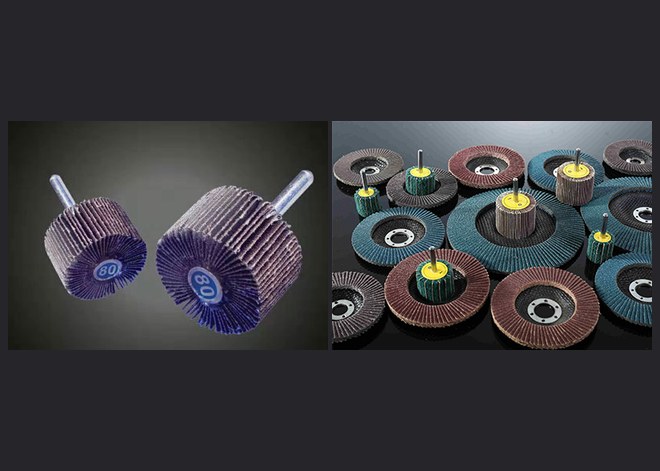
Choose by contact geometry, not by grit or price. If the tool can lay a flat face on the work, a flap disc wins on speed and levelness: weld blending on plate, beveling an edge, deburring after cutting, surface prep before paint. The backing plate holds the cut in one plane as the flaps wear.
If the surface curves away from a flat face, a flap wheel is the only one of the two that reaches it without gouging: tube interiors, fillets at pipe joints, grooves, turned profiles, inside corners. Where a job is both — a flat panel with a turned lip — run the field with the disc and the lip with the wheel; they are not substitutes for each other. New to the disc side? What a flap disc is and its main uses covers the basics.
The comparison holds for coated-abrasive flap products on steel, stainless and wood, run on the machines they are each designed for: the disc on an angle grinder spindle, the wheel on a die grinder or drill via its shank. Everything below follows from construction and contact geometry, which is why it holds across brands. Two things are deliberately left out: safe operating speeds and service life in hours — both depend on the specific product and machine, and belong in the manufacturer's data for the item you actually buy.
Five differences decide the choice. Everything else about the two products follows from them.
| Dimension | Flap wheel | Flap disc |
|---|---|---|
| Structure and mounting | Flaps bonded radially around a central core, mounted on a 6 mm shank in a die grinder or drill collet | Flaps bonded to a rigid or semi-rigid backing plate, mounted flat on an angle grinder spindle |
| Common sizes | 25 to 80 mm diameter, 5 to 25 mm thick | 100, 115 and 125 mm diameter — the standard angle-grinder sizes |
| Contact pattern | Curved, point-and-line contact that follows the surface | Broad flat face contact; the plate keeps the path level |
| Best-fit shapes | Internal diameters, tubes, channels, grooves, contours and turned profiles | Flat plate, long welds, bevels, large panels and edges |
| How it usually fails | Clogging on soft material; shank bending under side pressure; wear concentrates at the rim, so the profile it cuts changes over its life | Corners round off and stop cutting; the plate heats up on edge work; loading on soft metals |
Grit ranges overlap, and grade numbers do not travel between suppliers: a 120 from one maker is not a 120 from another. What changes is where you start — on a disc the first pass is usually the coarsest grade the maker lists, because the job is stock removal; on a wheel you can start finer, because the wheel is often the finishing tool rather than the roughing one. How hard the grain cuts at a given grade also depends on the flap material — flap wheel hardness and selection explains that variable.
The switch is forced by the shape of the part, not by the grit or the price: each tool quits where the other starts. Three signals show it on the floor.
The backing plate lifts off the work. A disc holds its cut in one plane only while the plate can sit on the surface. In an inside corner, a tube interior or a groove it either cannot reach or lands on its full plate and gouges the face beside the one you are working. Switch to a wheel here — our flap wheels run 25 to 80 mm on a 6 mm shank and get into those shapes.
The finish comes up scalloped. On pipe welds, formed edges and carved wood, a flat contact patch cannot follow the profile: it cuts the high points and skips the dips, leaving a rippled surface that needs a second operation to remove. A wheel that shrinks its contact patch to the shape of the work blends it in one pass.
The job is a meter of open weld. Small wheels remove material slowly. Stripping a long bead or beveling a plate edge with a mounted wheel wastes time and burns through several wheels — that job belongs to a flap disc or a grinding disc. The same holds for any cut that has to end in a straight, level plane: a wheel that conforms to the surface cannot also flatten it.
Ten minutes with two scrap coupons settles the choice faster than any chart:
If either tool loads up or glazes during the test, the grit is too fine for the material or the pressure is too light; change one variable at a time and re-run the pass.
Not a shank-mounted one. The wheels we make run 25 to 80 mm on a 6 mm shank, which fits a die grinder or drill collet; an angle grinder spindle takes disc-type products. Arbor-hole flap wheels for angle grinders do exist on the market, but they are a different product — check the bore and the marked maximum speed before you mount anything.
For flattening a panel or a slab, a flap disc on the grinder does the rough work quickly. For bowls, spindles, inside curves and final blending, the wheel is better because it follows the shape instead of fighting it.
Start at the coarsest grade the maker lists for that product only when you have real material to remove — weld blending on a disc is that case. If the goal is a finish rather than removal, start in the middle of the listed range and step finer. You can take another pass; you cannot put the material back.
No. A sanding disc is a single layer of abrasive on a backing; a flap disc is many overlapping layers that present fresh grain as the outer flaps wear. That is why a flap disc keeps cutting at a consistent rate while a sanding disc fades.

 English
 中文
 한국어
 français
 Deutsch
 Español
 italiano
 русский
 português
 العربية
 tiếng việt
 Polska