

An emery cloth roll — also sold as an abrasive cloth roll — is the right buy when the work would tear paper: tube and pipe interiors, weld blending, deburring, and any curved metal surface where the abrasive has to bend and take pressure. Three variables decide the roll: backing weight, roll width and grit. Backing decides whether the cloth conforms or holds flat, width decides where it wears and how much control the operator keeps, and grit decides the stage. Cloth costs more per meter than paper, so it belongs on round, hot, high-pressure metal work and nowhere else; on flat panels, wet work or fine wood finishing a paper roll is both cheaper and better.
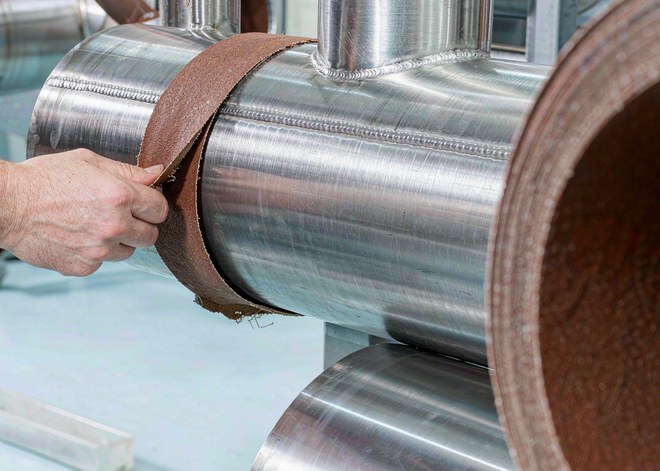
Cotton and polyester cloth, and blends of the two, are treated for tear strength and low stretch before any grain goes on. That is what lets a cloth roll bend around a pipe without creasing, survive being pulled hard into a weld seam, and keep its grain bed intact under pressure that would crack a paper backing. Paper is stiff in the wrong way and weak in the wrong direction: fold it around a tube and it fatigues at the fold line within minutes.
The bond is the second difference, and it matters on metal. Cloth is resin-bonded to hold grain at temperatures that would soften a light paper bond, and the better cloth lines also carry an anti-burn coating that keeps the backing from scorching when grinding generates real heat. On a job that sparks or runs hot, that coating is doing work, not marketing.
Where the two materials divide is set out in abrasive paper and cloth: cloth for round, hot and pulled; paper for flat, cool and fine. On the paper side, the equivalent selection logic is in how to choose a sandpaper roll.
The letter on the spec sheet describes the cloth, and it changes how the roll behaves more than the grit does. RMC's range divides cleanly into two families.
| Backing | Models | Behavior | Fits | Does not fit |
|---|---|---|---|---|
| Jwt — lighter poly-cotton | AJ23, AJ25, AJ26, CJ25 | Flexible, hand-tearable, conforms to radius | Tube and contour work, hand-held strips, narrow belts, soft metals | Flat heavy stock removal; it follows the shape instead of cutting it flat |
| Xwt — heavier cloth | AX45, AX67, ZX67F | Stiff, high tensile strength, holds shape under pressure | Weld blending, machine rolls, belt and flap-wheel conversion, high-speed work | Tight inside radii and hand-wrapped profiles |
The rule: if the roll has to wrap, go lighter than feels safe. If it has to remove metal flat and fast, go heavier. Xwt is also the grade that converts well — AX45 and ZX67F are both used to make flap wheels and flap discs, which is why they show up in shops that build their own tooling rather than only buying it.
The letter in front of the model number tells you the grain, and the three behave differently enough to matter.
Aluminum oxide (A) — AJ23, AJ25, AJ26, AX45, AX67. The general-purpose choice for mild steel, brass, copper, hardwood and softwood. AJ26 adds a stearated coating for stainless and general metal polishing, where loading is the limit rather than cut rate.
Silicon carbide (C) — CJ25. Sharper and more friable, best on soft, gummy metals: copper, aluminum and zinc alloys, where an aluminum-oxide grain would load before it dulls. Also the finer-finishing end, with grades up to P800.
Zirconia (Z) — ZX67F. The heavy-duty option for stainless welds, oxide skin and weld spots, where pressure and heat are both high. It is the grade to reach for when a weld has to come down fast without the cloth glazing.
Matching grain to workpiece is where most of the cost difference sits. A zirconia roll run on soft aluminum wastes its toughness; a silicon carbide roll run on stainless wears out early because the pressure needed exceeds what the friable grain tolerates.
Width decides where the cloth wears and how much control the operator keeps, and it should follow the contact patch rather than the workpiece.
Narrow widths handle tube interiors, pipe welds and detail deburring, where a wide roll only rounds over the edges you wanted crisp. Mid widths suit hand-block work on flats and machine rolls for panel weld cleanup. Wide rolls belong on power-driven setups leveling large areas, where the machine keeps the cloth flat and the operator is not fighting it.
If operators tear short sections by hand all day, a narrower roll wastes less at the tear line than a wide roll cut down repeatedly. Published spec tables list grain, backing, bond, grit and available forms; width is quoted to order, so state the width and core you need rather than assuming a stock size.
The grit logic mirrors paper: each step removes the scratch pattern of the one before. On metal the working ladder looks like this.
Heavy scale and weld knockdown start at P40 to P80 — CJ25 covers this range on soft metals, AX67 on steel and stainless. Weld blending and edge prep sit at P120 to P180, which is where AJ23's semi-open coat keeps the sheet from loading as the surface starts to clean up. Surface prep before a coating lands at P240 to P320; 320 grit emery cloth is the common stopping point before paint or a brushed finish. Refining, at P400 to P600, is where 600 grit emery cloth takes over for a finer scratch before buffing or a satin grain.
Two practical notes. First, cloth leaves a slightly coarser scratch than paper at the same grit, because the weave does not present the grain as flat — for the last pass before a fine finish, paper or film wins. Second, on stainless keep pressure light: heat tint is what you are trying to remove, and pressing hard puts it back.
The full emery cloth roll range is organized by these model numbers, and each product page carries its own grain, backing, bond and grit table, so the spec you quote matches the grade you receive.
Four fields close an order without a follow-up email: backing weight (Jwt or Xwt), grain (A, C or Z), grit, and form — full roll, slit roll or converted belt. Add width, core diameter and the machine or hand tool it feeds if the roll has to fit something. If a model page does not answer one of those fields for your application, ask for the spec sheet before the PO, not after.
Backing and duty. Emery cloth carries abrasive grain on treated woven cloth for flexing, tension and heat on metal; sandpaper carries it on paper for flat, cooler, lighter work. Modern emery cloth usually runs aluminum oxide, silicon carbide or zirconia rather than natural emery, whatever the name still says.
Start at P80 on heavy scale and move to P120–P180 as the surface cleans up. Coarser than P80 digs uneven pits into good metal, and finer grits at the start just load with rust powder. On light surface rust, a P120 pass is often enough before blending.
Neither is better; they do different jobs. Jwt wraps tubes, profiles and curves and can be torn by hand. Xwt holds shape under pressure and is the grade for weld blending, machine rolls and belt conversion. Choose by whether the roll has to bend or has to press.
Yes, with the right grade and a light touch. Zirconia (ZX67F) or stearated aluminum oxide (AJ26) are the usual picks for stainless welds and blending. Keep pressure light and the roll moving, because stainless discolors when it overheats and heat tint is exactly what the pass is supposed to remove.
Three habits: match roll width to the tube so the cloth is not forced to fold over an edge, keep the roll moving so no strip takes all the pressure, and drop to a Jwt backing for tight radii. Stiffness, not grit, is what snaps first on a tube.

 English
 中文
 한국어
 français
 Deutsch
 Español
 italiano
 русский
 português
 العربية
 tiếng việt
 Polska