

Aluminum oxide sandpaper is the default grain for wood and ferrous metal: brown fused alumina is a tough, blocky grain that blunts slowly, so a sheet keeps cutting through long dry runs. Silicon carbide sandpaper is the grain for glass, stone, ceramics, paint and clear coat, and for wet sanding: its crystals are slightly harder — about 9.1 on the Mohs scale against 9 for fused alumina — and they micro-fracture under load to expose fresh edges instead of glazing. Grit number is a separate choice from grain type: P120 silicon carbide and P120 aluminum oxide sit in the same particle-size class, so you keep your grit ladder and change only how each stage cuts.
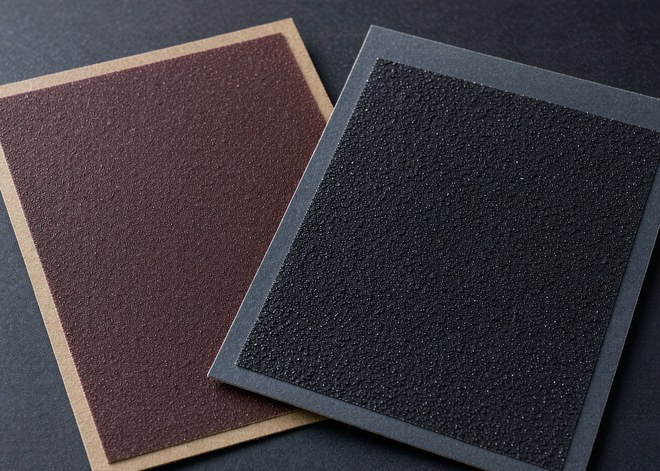
Both minerals sit around Mohs 9, so hardness is not what separates them — the way they wear is.
Brown fused aluminum oxide forms as dense, large crystals surrounded by grain boundaries, which make the grain tough: it absorbs impact and blunts instead of cracking, and that is why it dominates dry wood and metal work. Washington Mills' fused mineral data lists fused alumina at Mohs 9 and silicon carbide at 9.1, and attributes brown alumina's toughness to exactly those large bonded crystals. (Source: Washington Mills, Fused Mineral Properties)
Silicon carbide runs the opposite trade-off. Its crystals measure 25,000–30,000 N/mm² on the Knoop scale and dissolve in neither acids nor bases, which matters when the paper runs under water. Under pressure, the sharp angular crystals fracture to expose new cutting edges — a friable wear pattern that keeps the surface cutting on hard, brittle materials, where a blunted tough grain would only rub and heat. (Source: Washington Mills, SiC Properties)
Grain shape compounds this. Coated abrasives cut better with angular grain, which stays sharp longer; silicon carbide is characteristically sharp-edged, while brown alumina is blocky and tough. A third mineral, white fused alumina, is a purer and more friable alumina that sits between the two in cutting character, and it is a common choice for fine finishing papers. For the market-side case for this mineral as an abrasive, see our overview of the advantages of silicon carbide.
Choose the grain by the surface first and the process second. The table below is the working assignment for a typical waterproof abrasive paper line.
| Surface | Grain to start with | Why |
|---|---|---|
| Wood, dry (hardwood and softwood) | Aluminum oxide | Tough grain survives impact; friable silicon carbide sheds edges too fast in dry stock removal |
| Steel and iron: rust, welds, deburring | Aluminum oxide | Blocky grain handles metal prep and keeps cutting through long runs |
| Aluminum, brass, copper | Silicon carbide | Suits low-tensile, ductile non-ferrous metals with a clean shearing cut |
| Paint, primer and clear coat | Silicon carbide | Sharp edges shear the film instead of loading; standard grain in automotive refinishing, wet or dry |
| Glass | Silicon carbide, wet | Brittle surface needs shearing edges; aluminum oxide glazes and heats |
| Stone, marble, granite | Silicon carbide, wet | Same brittle-material logic as glass |
| Ceramics and porcelain | Silicon carbide | Grain manufacturer data lists ceramics, glass and cast iron as silicon carbide applications |
Source for the non-ferrous and brittle-material rows: Washington Mills' CARBOREX grain data lists grinding "hard or brittle materials such as cast iron, ceramics, and glass" and "low tensile strength, ductile, non-ferrous metals" as silicon carbide applications. (Source: Washington Mills, CARBOREX Silicon Carbide)
Both grains are manufactured across the same FEPA grit sizes, so the assignment above is about grain behaviour, not grit availability. Most dry aluminum oxide stock removal runs through roll and belt formats — the aluminum oxide sandpaper rolls page lists the widths and grits available.
Silicon carbide is the default wet grain and aluminum oxide the default dry grain — but the backing, not the grain, decides whether a sheet survives water.
Silicon carbide's case for wet work is chemical and mechanical at once: the mineral dissolves in neither acids nor bases, and its sharp edges shear rather than tear, so a water-fed sheet keeps cutting while the water clears swarf and holds temperature down. That is why most conventional wet/dry paper is silicon carbide on a water-resistant latex backing — see the silicon carbide waterproof paper range for the product family.
Aluminum oxide works wet too, where the product allows it. Waterproof aluminum oxide paper pairs the tough grain with a waterproof latex backing and resin bond; ordinary dry-grade sheets on glue bonds can soften or delaminate once soaked. If you are weighing wet sandpaper vs dry grades, check the backing and binder first — they fail before the grain does.
Each grain fails in the other's home territory.
Grain type is a spec you can demand in writing, not something to guess from color.
Ask a supplier to state, per product: the abrasive mineral (brown fused alumina, white fused alumina, black or green silicon carbide), the backing weight and type (A-, C- or D-weight latex paper), the bond system (glue-over-glue, resin-over-glue or resin-over-resin) and the grit classification standard (FEPA P or ANSI). A supplier who names all four on the datasheet is telling you what is on the paper; one who answers only with a grit number is not.
Color is a weak signal. Black silicon carbide and treated aluminum oxide can look alike in a finished sheet, and green silicon carbide is a distinct higher-purity grade rather than a color code for "finer". The quick field check is a cut test on a scrap of glass: silicon carbide bites immediately, while a blunted aluminum oxide sheet skates and heats.
If you would rather have the grain-and-backing combination confirmed for your process than run the datasheet hunt yourself, send us the surfaces you sand, the grit range you run and whether you work wet or dry — we will match the spec to the right waterproof paper, with spec sheets available on request.
Marginally. Fused alumina measures about 9 and silicon carbide about 9.1 on the Mohs scale, and silicon carbide reaches roughly 25,000–30,000 N/mm² on the Knoop scale. In practice the difference that matters is structure, not hardness: silicon carbide is sharp and friable, aluminum oxide tough and slow-blunting.
Depends on the surface. On wood and steel, tough aluminum oxide outlasts silicon carbide because it blunts slowly instead of fracturing. On glass, stone and paint, silicon carbide stays effective longer because fresh edges keep forming while blunted aluminum oxide glazes. Sheet life follows the match between grain and material.
Yes. FEPA grit designations describe particle-size classes independent of the abrasive mineral, so P400 silicon carbide and P400 aluminum oxide cover the same size range. Changing grain does not change your grit ladder; the classification is defined by FEPA, the European Federation of Abrasive Producers.
Only if the backing and bond are built for water. Waterproof aluminum oxide paper uses a water-resistant latex backing with resin bonds, and most coated-abrasive lines offer it. Ordinary dry-grade aluminum oxide on glue bonds can soften or delaminate once soaked, so check the backing spec before you wet any sheet.
Paint film is exactly where a tough grain fails: blunted edges rub and heat instead of shearing, and the softened film loads the paper surface. Switching to silicon carbide fixes it — sharp, self-renewing edges cut the film cleanly, which is why refinish work defaults to silicon carbide wet/dry paper.

 English
 中文
 한국어
 français
 Deutsch
 Español
 italiano
 русский
 português
 العربية
 tiếng việt
 Polska