

When an abrasive fails to perform as expected, the abrasive grain is often the first component to be examined. Yet the layer supporting the grain can be equally important. Backing determines how an abrasive responds to bending, pressure, repeated contact, and the movement of a grinding tool. It also affects how consistently the abrasive remains in contact with the workpiece as the surface changes.
This is where cloth backing becomes particularly valuable. Compared with more rigid backing materials, textile-based constructions can provide a useful combination of flexibility, tensile strength, and resistance to repeated mechanical stress. These characteristics make cloth abrasive rolls and cloth sanding belts suitable for applications ranging from controlled surface preparation to demanding grinding and finishing operations.
Understanding the relationship between backing construction and abrasive performance helps users make better decisions about durability, flexibility, cutting behavior, and surface finish. Rather than selecting an abrasive only by grain type or grit size, it is more effective to consider how the backing will behave under the actual conditions of use.
Abrasive backing provides the structural foundation that holds the abrasive grain in place and transfers mechanical force to the workpiece. Common backing materials include paper, film, and textile-based substrates. Each has a different balance of flexibility, stiffness, strength, and resistance to mechanical stress.
Cloth backing is distinguished by its woven or textile structure. Depending on the construction and intended application, the backing can be engineered to provide different levels of flexibility and tensile strength. This allows abrasive manufacturers to adapt the backing to applications where the abrasive must bend around a workpiece, withstand repeated movement, or tolerate relatively demanding grinding conditions.
Paper backing can be effective for many general sanding operations, particularly where a relatively flat and stable abrasive surface is required. Film backing can offer dimensional consistency and a smooth working surface. Cloth backing, however, is often selected when the abrasive needs to withstand greater mechanical movement without sacrificing useful flexibility.
| Backing Characteristic | Cloth Backing | Paper Backing | Film Backing |
|---|---|---|---|
| Flexibility | Available in a wide range of flexibility levels | Generally suitable for controlled sanding applications | Typically stable and dimensionally consistent |
| Tensile strength | Well suited to applications involving repeated mechanical stress | More dependent on paper grade and construction | Generally strong and dimensionally stable |
| Conformability | Suitable for flat, curved, and shaped surfaces depending on construction | Varies with paper weight and grade | Often better suited to controlled surface contact |
| Typical application focus | Grinding, deburring, blending, sanding, and finishing | General sanding and finishing | Precision sanding and consistent surface finishing |
| Resistance to repeated bending | Generally well suited to repeated flexing | More limited depending on construction | Depends on film formulation and thickness |
The important point is that “cloth backing” does not describe a single performance level. Different cloth constructions can be engineered for different degrees of flexibility, strength, and surface conformity. The backing should therefore be selected according to the application rather than treated as a universal specification.
Flexibility determines how readily an abrasive follows the geometry of a workpiece. On a flat surface, backing flexibility may have relatively little influence because the abrasive can maintain broad contact. Once the surface includes curves, edges, transitions, or irregular profiles, the backing has to accommodate changes in contact angle without losing effective abrasive contact.
This is one reason cloth abrasive rolls are useful for applications where operators need to sand across changing surface geometries. A flexible cloth backing can bend and conform to the workpiece, allowing the abrasive grain to remain engaged across a larger portion of the working area.
Flexibility also affects hand control. When sanding a curved component, an excessively rigid backing can concentrate pressure at specific contact points. A suitably flexible backing can distribute the contact more naturally, helping the operator maintain a more consistent sanding motion.
For cloth sanding belts, flexibility becomes particularly relevant because the abrasive continuously travels around the belt path while also contacting the workpiece. The backing must flex repeatedly without becoming so compliant that the belt loses the stability required for controlled cutting.
The ideal balance therefore depends on the operation. A highly flexible abrasive may be advantageous for contour sanding and finishing, while a more robust and stable backing may be preferred when the process requires stronger cutting action or greater dimensional control.
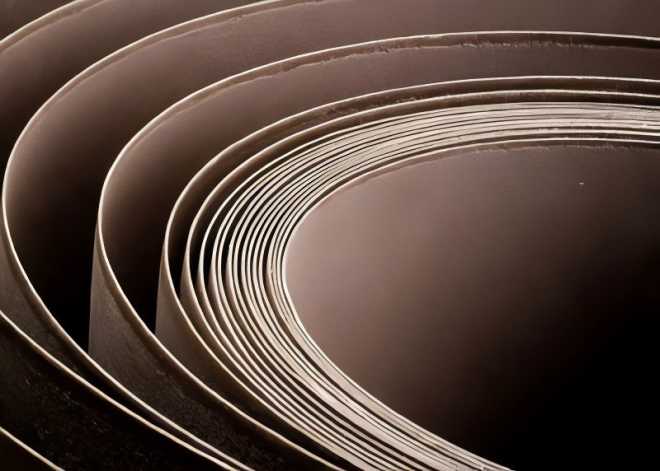
Flexibility alone does not determine the useful life of an abrasive. The backing must also withstand the mechanical forces generated during sanding and grinding. Tension, bending, friction, edge loading, and repeated contact can all place stress on the backing, particularly in continuous abrasive applications.
Cloth construction can provide a strong foundation for these conditions because the textile structure distributes mechanical stress through the backing rather than relying on a comparatively brittle substrate. This does not mean every cloth-backed abrasive has the same tear resistance. The actual performance depends on the fabric construction, coating system, backing weight, abrasive bonding, and intended use.
For cloth abrasive rolls, backing strength is especially important when the material is pulled, folded, wrapped around a component, or used repeatedly during manual sanding. A backing that combines adequate tensile strength with controlled flexibility can help the abrasive remain functional throughout the intended working cycle.
In cloth sanding belts, the backing has another demanding role: it must withstand continuous bending and belt tension. If the backing cannot tolerate these stresses, premature cracking, stretching, edge damage, or other forms of failure may affect belt performance even when the abrasive grain itself still has useful cutting potential.
Durability should therefore be evaluated at the system level. A strong backing cannot compensate for an unsuitable abrasive grain or bonding system, but an appropriately engineered backing can help the abrasive structure make better use of the available grain throughout its working life.
The abrasive grain performs the actual cutting, but the backing determines how securely and consistently that grain is supported. During grinding, the abrasive encounters pressure, friction, vibration, and localized impact. The backing and bonding system must keep the abrasive layer sufficiently stable while allowing the abrasive to respond to the workpiece.
A well-matched cloth backing helps distribute mechanical forces across the abrasive structure. Instead of allowing stress to concentrate excessively around individual grain areas, the backing provides a flexible structural base that supports the abrasive layer during movement.
This relationship becomes particularly important when grinding pressure increases. If the backing is too weak for the application, deformation or mechanical damage can interfere with the cutting process. If it is excessively rigid for a contoured application, the abrasive may struggle to maintain consistent contact with the workpiece.
The backing therefore contributes indirectly to cutting efficiency. It does not determine the sharpness of the grain, but it influences how consistently the grain can engage with the material. This is one reason professional abrasive selection should consider grain, bond, backing, and application conditions as a complete system.
For users comparing different abrasive solutions, Riken's range of abrasive products provides a useful reference point for evaluating abrasive construction according to different grinding and finishing requirements.
Grinding pressure has a direct effect on how abrasive grains interact with the workpiece, but the response of the backing determines how that pressure is distributed. A rigid backing tends to maintain a more defined contact geometry, while a flexible backing can adapt as the workpiece profile changes.
For flat surfaces, a stable backing can help maintain consistent contact and controlled material removal. For curved surfaces, a certain degree of flexibility may be more valuable because it allows the abrasive to follow the contour rather than concentrating pressure along a narrow contact zone.
This balance is particularly relevant when using cloth abrasive rolls for blending or finishing. Excessive pressure can remove material too aggressively or create an inconsistent surface, while insufficient pressure may reduce cutting efficiency. A backing with appropriate flexibility gives the operator greater control over how the abrasive responds to changes in pressure.
The same principle applies to cloth sanding belts. Belt tension, contact pressure, belt speed, and backing flexibility interact during operation. A backing that is appropriately matched to the machine and workpiece can help maintain stable abrasive contact while allowing the belt to follow the required working profile.
Surface finish should therefore not be considered separately from backing design. A consistent finish depends on the relationship between abrasive grain, grit size, backing flexibility, applied pressure, machine conditions, and workpiece geometry. When these factors are properly matched, the abrasive can provide more predictable material removal without unnecessary surface variation.
Selecting cloth backing starts with understanding what the abrasive will experience during use. The first consideration is the shape of the workpiece. Flat components may benefit from a backing that emphasizes stability, while curved or irregular surfaces generally require greater flexibility and conformability.
The second consideration is the level of mechanical stress. Light finishing operations do not place the same demands on the backing as aggressive grinding, deburring, or continuous belt sanding. When the abrasive will experience repeated bending, tension, or high contact pressure, backing strength and tear resistance become increasingly important.
For manual sanding, cloth abrasive rolls can be selected according to the required balance between flexibility and durability. Flexible grades can be useful for contour work and finishing, while stronger constructions may be more appropriate when the application involves heavier sanding or greater mechanical stress.
For machine sanding, cloth sanding belts should be matched to the belt machine, workpiece material, contact geometry, and desired removal rate. Belt construction needs to provide enough flexibility to operate smoothly while retaining sufficient strength to withstand continuous movement and tension.
Material compatibility is another important factor. Steel, stainless steel, aluminum, wood, coatings, composites, and other substrates can require different abrasive characteristics. Grain type and grit remain important, but the backing should support the intended cutting action rather than be selected independently.
Finally, application testing is often the most reliable way to confirm a backing choice. Actual sanding conditions can reveal differences in flexibility, abrasive loading, edge durability, cutting consistency, and final finish that are difficult to determine from a specification sheet alone. When a project involves demanding or specialized requirements, users can contact Riken's technical team to discuss the workpiece, sanding process, and required abrasive performance.
Abrasive cloth backing plays a structural role in determining how an abrasive behaves under real grinding and sanding conditions. Its flexibility affects conformability and control, while its strength and tear resistance influence durability under repeated mechanical stress. The backing also supports the abrasive grain and helps determine how consistently cutting forces are transferred to the workpiece.
For this reason, selecting between different cloth abrasive rolls and cloth sanding belts should involve more than comparing grit sizes. Workpiece geometry, grinding pressure, machine conditions, required flexibility, mechanical stress, and desired surface finish all need to be considered together.
When backing characteristics are properly matched to the application, the abrasive can deliver more stable cutting behavior, better surface control, and more predictable service performance. That makes cloth backing an important part of abrasive selection rather than simply a support layer behind the grain.
Abrasive cloth backing is a textile-based substrate that supports abrasive grains and provides a combination of flexibility, strength, and mechanical durability for sanding and grinding applications.
Cloth abrasive rolls are commonly used for manual sanding, blending, deburring, surface preparation, and finishing where flexibility and durability are required.
Cloth sanding belts can provide the flexibility and tensile strength needed to withstand repeated bending, belt movement, and mechanical tension during continuous sanding operations.
Yes. Backing affects how pressure is transferred to the abrasive layer and how consistently the abrasive maintains contact with the workpiece, which can influence cutting behavior.
No. Flexibility should match the application. Highly flexible backing can improve contour conformity, while stronger and more stable backing may be preferable for demanding grinding or high-pressure operations.
Consider the workpiece material, surface geometry, sanding method, pressure, required removal rate, machine conditions, and desired finish. Application testing or technical consultation can help confirm the most suitable backing construction.

 English
 中文
 한국어
 français
 Deutsch
 Español
 italiano
 русский
 português
 العربية
 tiếng việt
 Polska